

This article aims to provide a comprehensive overview of the key characteristics of global climate change and the significant risks it poses to the real estate and property insurance industries. By drawing on recent experiences with an insurance client, we also highlight practical strategies and innovative solutions that can be adopted to effectively manage and mitigate climate-related risks.
Through the implementation of these measures, our client successfully avoided losses exceeding USD 20 million and achieved a remarkable 12.9% increase in the net margin of their business stream. By embrac-ing proactive approaches, fostering collaborative partnerships, and leveraging technological advancements, insurance companies can navigate the complexities of climate change, offer sustainable insurance solutions, and contribute to building a more resilient and sustainable future.
Climate Change Around the World
The world stands on the precipice of a climatic revolution, as the forces of nature unleash their might in unprecedented ways. Soaring temperatures drive the dance of increasingly frequent and intense extreme weather events, wreaking havoc on our planet. Currently, the primary characteristics of global climate change can be summarized as follows:
oTemperature rise: Global temperatures have increased by 1.1°C over past century (around 16 times faster than the average rate of warming coming out of the last ice age) and are expected to further increase by 3°C to 6°C by end of twenty-first century, leading to more frequent and intense extreme weather events and various climate change-related issues.
oIncrease in extreme weather events: Climate change has resulted in a rise in the frequency and intensity of extreme weather events, such as rainstorms, hurricanes, droughts, and floods. As just one example, it has been estimated that climate change increased the rainfall from Hurricane Harvey by about 15% (Van Oldenburgh et al., 2017). These events pose risks and losses to the real estate and property insurance industries.
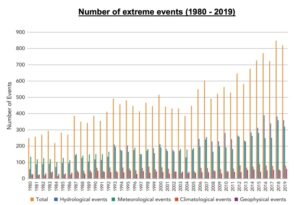
- Sea level rise: Global warming is causing the melting of glaciers and ice sheets, resulting in elevated ocean water levels (44-76 cm above today’s levels by 2100 under the most likely emission & climate scenarios). This presents potential risks to coastal real estate, including increased coastal erosion and flood hazards.
- Ecosystem collapse: Climate change is exerting pressure on ecosystems, including the degradation of forests, coral reefs, and other vital habitats. This can impact the real estate industry through soil erosion and a decrease in biodiversity.
It is important to note that while these trends are global, they may vary in different regions. Climate change has also resulted in synchronized climate risks, encompassing physical risk and transformation risk. Physical risk refers to direct threats caused by climate change, such as property damage resulting from natural disasters. Transformation risk involves economic, legal, technological, and other risks that may arise during the process of adapting to climate change.
Therefore, it is crucial for the real estate and property insurance industries to understand and adapt to the impacts of climate change and climate risk trends. Physical risks can directly impact real estate businesses, leading to house and property damage, as well as business interruptions caused by extreme weather events. Rising sea levels can devalue coastal real estate assets and increase risks in these areas. Droughts and floods can also cause damage to land, buildings, and infrastructure. Transformation risks primarily manifest as uncertainty and adjustment costs during the transition process. For example, governments may introduce new climate policies and regulations that require sustainable development and low-carbon transformations in the real estate industry. This may necessitate technological and energy upgrades, resulting in increased costs and risks.
Climate risk has also significantly impacted the insurance industry, posing substantial challenges in addressing climate change. These challenges include:
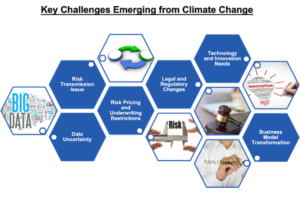
Insurance works best when a large pool of participants (motorists, corporations, homeowners, etc.) all have a small, and close-to-equal, chance of being struck by misfortune, and when these accidents or other losses follow predictable patterns discernible from historical data. The problem with climate risk, especially some types of physical climate risk, is that the risks become so concentrated that the risk of underwriting affected facilities and properties in those areas can grow too high to be economical.
Background and Situation
To actively address these difficulties and challenges, insurance companies should strengthen cooperation with the scientific community, government, and other stakeholders to effectively manage and mitigate climate-related risks and provide appropriate and sustainable insurance solutions to customers.
As a consulting company with a long-term focus on sustainable development and extensive experience withthe insurance industry, we actively assist clients in coping with climate change. Recently, we collaborated with a leading global insurance company to develop a customized insurance plan for the Hong Kong real estate market, which is particularly affected by climate change, to address the physical risks posed by extreme weather events on real estate projects.
Due to the increasing frequency and unpredictability of extreme weather events in recent years, our clients have incurred losses of more than USD 20 millions in the real estate insurance business in Hong Kong. Therefore, the client has sought our assistance in evaluating the feasibility of the business and enhancing its profitability.
Recent Practice with one of our Insurance Clients
Our Approach
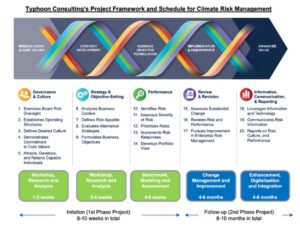
During the risk assessment stage, we conduct big data analysis and modeling using housing information, macroeconomic data, climate data, and historical real estate transactions. This enables us to effectively identify regions most affected by climate change, key climate risk variables, and critical time windows for value changes.
In the product design stage, we further remodel and predict risk exposure and loss probabilities for different regions, real estate projects, and targeted assets. This allows us to design insurance products tailored to each set of real estate, ensuring overall business returns.
In the exploration phase of risk transmission and sharing mechanisms, we work closely with reinsurance companies and explore innovative risk transfer solutions such as catastrophe bonds, parametric insurance, and risk pools. These mechanisms help spread and diversify the risks associated with climate change, ensuring the stability and sustainability of the insurance business.
Outcome and Impact
Throughout the project, we also collaborate with government agencies, research institutions, and industry experts to gain insights into legal and regulatory changes, emerging technologies, and best practices in climate risk management. This allows us to provide our clients with comprehensive and up-to-date guidance on adapting to the evolving landscape of climate change.
Ultimately, through the successful implementation of this project, we have enabled our clients to undergo a business restructuring within a remarkably short span of 11 months. Our efforts have yielded significant improvements in operational capabilities, as well as the seamless integration of ESG factors into their insurance business. This comprehensive approach also promises to enhance the overall profitability of the business, with an anticipated shift from a USD 20 million loss to a USD 30 million gain and projected improvement in the net margin from -5.3% to 7.6%, as predicted by our simulation model. Furthermore, our approach ensures effective management of underwriting risks, aligning the business with sustainable development goals.
Our Perspectives, Thoughts and Suggestions about Future
Based on the afore-mentioned cases, it is evident that insurance companies have a significant opportunity to enhance various insurance operations in the context of climate change. The following measures can be considered:
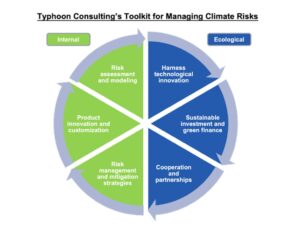
- Risk assessment and modelling: Strengthen the assessment and re-calibrate existing models for climate-related risks, encompassing extreme weather events, natural disasters, and sea-level rise.
- Product innovation and customization: Develop insurance products and services that adapt to climate change and cater to the specific needs of customers.
- Risk management and mitigation strategies: Collaborate with clients to devise risk management and mitigation strategies that minimize losses and risks.
- Cooperation and partnerships: Establish partnerships with governments, scientific communities, non-profit organizations, and other stakeholders to collectively address climate change risks.
- Sustainable investment and green finance: Actively invest in renewable energy, low-carbon technologies, and other environmental protection sectors to foster sustainable development.
- Harness technological innovation: Utilize advanced technology and data analysis tools to enhance the efficiency and accuracy of risk assessment, risk management, and claim processing.
According to Typhoon Consulting’s extensive experience, we have the expertise to assist insurance companies in enhancing their efforts in risk assessment, product innovation, risk management, partnerships, and technological advancements. These multi-phased initiatives enable them to effectively carry out property insurance operations in the face of climate change.
It is important to note that this example is just one illustration of our experience, as we have also served numerous clients across various industries in their sustainable development endeavors. By implementing these measures, our clients can proactively address climate change risks, offer sustainable products and solutions, and create enhanced value for both customers and society at large.
Reference
Boyer, Tim P.; Smolyar, Igor V., et al. (2018). World Ocean Atlas 2018. NOAA National Centers for Environ-mental Information.
https://accession.nodc.noaa.gov/ NCEI-WOA18
Van Oldenburgh, R., Haigh, I., Kingston, D., & Smith, R. (2017). The extreme rainfall of Hurricane Harvey in context.
https://www.nature.com/articles/s41467-017-00999-w
COSO. (2017). Enterprise Risk Management: Integrating with Strategy and Performance
https://www.coso.org/Documents/2017-COSO-ERM-Integrating-with-Strategy-and-Performance-Executive-Summary.pdf
COSO and WBCSD. (2018). Enterprise Risk Management: Applying enterprise risk management to environmental, social and governance-related risks.
https://www.coso.org/Documents/COSO-WBCSD-ESGERM-Guidance-Full.pdf
GARP (Global Association of Risk Professionals). Sustainability and Climate Risk Exam, published by Pearson Education.
https://full-bookshelf.vitalsource.com/reader/books/9780138089238

