

Driving change once again
As Global Vaccination programmes take shape and businesses emerge from the Covid-19 pandemic, Typhoon Consulting is launching a series of articles to explore how businesses can drive their change activities in a post Covid-19 era and will provide guiding principles to support your organisation plan and deliver change.
2020 was a year like no other with the uncertainty of Covid-19 driving organisations to amend their business models at pace, increasing remote working and innovating to deliver new ways of working. However, with the current vaccination status in the UK totalling c.24 million and number of cases dropping 15 % on average week on week, we are beginning to see light at the end of a long tunnel.
Organisations are now looking to the future to develop a roadmap to not only emerge from this pandemic but to thrive in a post Covid era. Businesses still have many challenges to face as change portfolios were paused over the last year, however in response to an evolving landscape it is pivotal that organisations and leadership teams become more agile and adaptable.
The following articles will delve into the key themes of change as well as how businesses will respond to these within a post Covid-19 era.
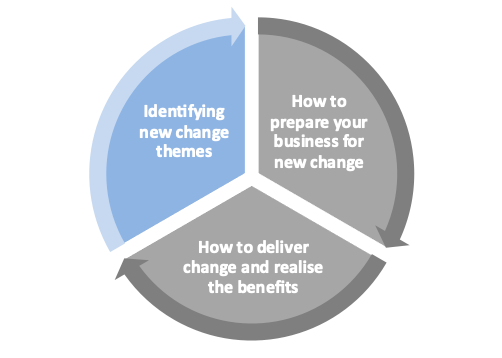
Key Themes Of Change
As we emerge from a global pandemic, businesses are realising that change will look different in a post Covid-19 era. In the first article of this series, we explore these themes and identify what organisations deem as a priority
Return of the office?
Organisations have quickly adapted to the necessity of virtual working over the past year however as lockdown begins to ease, many businesses are planning what the future of the workplace will look like.

Throughout the first phase of the pandemic, businesses faced challenges such as a loss of collaboration, a decrease of productivity and a lack of community feel; however with the adoption of new tools, cultural transformations and new ways of working, businesses were largely able to overcome these. There is now growing evidence flexible working is here to stay with companies such as Microsoft, Twitter and Schroders all offering a flexible remote working model to employees.
- Hybrid Model: A survey taken suggests that 72% of individuals would prefer a hybrid remote / office model moving forward providing them the ability to choose how and from where they can work. Throughout the pandemic, we have seen many people leave the larger cities in favour of more space and hence a hybrid model offers less commuting and increased wellbeing.
- Redesign: The pre-covid model of a “sea of desks” is likely to be a thing of the past. Many business are considering how they can redesign their offices to become more equipped for training and events rather than desk space. We may even see a shift from having a large centrally located inner city office spaces to increased number of regional offices and higher uptake of flexible working spaces.
Reskilling the workforce
The past year has seen a rapid evolution of new skills, ways of working and technologies. This is seen across all industries from healthcare professionals diagnosing patients over video, to the hiring and onboarding of new employees remotely.
However, the adoption of new technologies leads to the necessity of ensuring businesses have the correct capabilities within their workforce and subsequently the ability to upskill and train employees. Past training methods will be required to be adapted to allow for virtual e-learning as well as embedding more remote social learning such as coaching, mentoring and peer feedback which would previously occur “side of desk”.
Digital: A must-have
Covid-19 has accelerated digital transformation for many organisations with high proportions of employees working remotely and communicating with colleagues using a wide array of collaboration tools, data sharing capabilities and synchronised work experiences.

Microsoft Teams and Slack have become the norm for many of us while an emergence of new tech and collaboration tools are still being created such as Zoho Projects, a project management software planning projects, and Hinterview, a video platform for recruitment allowing videoing and sharing of interviews and creation of shortlists. In addition to new collaboration tools, adoption of Cyber Security, Advanced AI, Automation and Machine Learning tools across the workforce is driving the digital transformation boom.
However, with the reward of new digital capabilities comes the risk that implementation and adoption is not properly managed, resulting in reduced effectiveness. Hence businesses need to ensure they have the appropriate mitigation and governance in place to manage within a new digital world
Culture is crucial
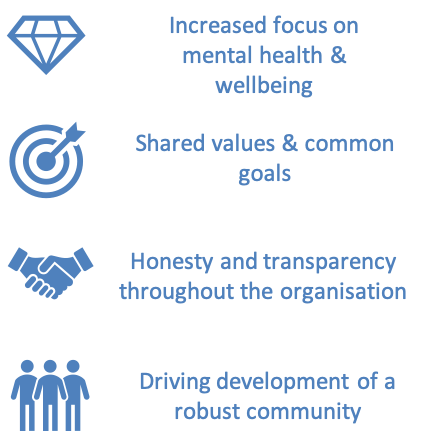
Driving culture initiatives and embedding a community feel within an organisation has faced its challenges over the past year. However, studies show that more employees than not feel the culture of their organisation has improved rather than deteriorated.
Businesses are putting much more of an emphasis on culture with a focus on the employee and their wellbeing. Lockdown and remote working has blurred the line between work and home life which has meant people can truly bring themselves to the workplace forging stronger and longer lasting relationships between colleagues.
Becoming sustainable and going green

Covid-19 saw a 17% reduction in the global carbon footprint as a direct result of most countries entering a form of lockdown. Many organisations are now beginning to prioritise sustainability on their corporate social responsibility agenda such as Ikea sourcing 50% of materials from sustainable woodland.
In addition to reducing a business’ carbon footprint, leadership teams are seeing this as an opportunity to engage a more socially conscious employee.
Even with a plan in place, an organisation will not successfully become more sustainable overnight, if cannot drive awareness and embed cultural habits within their organisational culture.
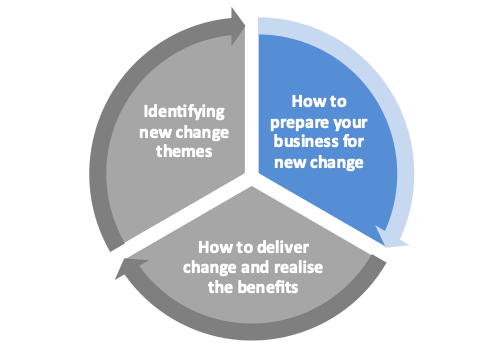
Planning change in a new world
Planning for change has certainly had its challenges over the past year, however as restrictions continue to lift, businesses are preparing for a post Covid-19 era. In the second article of the series, we explore how businesses are planning for further change.
Reflect on your business
Many organisations have had to evolve and adapt as a result of the pandemic. This has led to altered business models, amended organisational structures, cultural transformations, and revisions to the nature of work and stakeholder engagement.
Before any strategic initiatives are launched, it is necessary to reflect on the operational and external environments to create a new baseline; once this has been ascertained, an organisation’s future strategy and metrics can be defined.
The greatest danger in times of turbulence is not the turbulence; it’s to act with yesterday’s logic.
-Peter Drucker
The time for change is now
Change portfolio prioritisation is pivotal to ensure your business thrives in a post Covid-19 era. Most change portfolios have been put on the back burner in the past year, however, now is the time to review your portfolio and evaluate which initiatives offer the greatest value against a set of consistent measures defined within your strategy.

Each business has a varying definition of “value”; hence it is crucial to reassess what value means for your organisation and to prioritise your change portfolio accordingly. Once the portfolio has been prioritised, budget can be allocated to those initiatives with the greatest importance and an implementation roadmap designed.
Location, location, location
Many employees wish to know their company’s plan for the returning to the office. While many of us long to be at a desk, many people’s mental health and wellbeing has improved from working from home with less commuting and more time spent with family. A two-pronged approach should be taken to defining your location strategy.
Digital online surveys to assess:
- Desired frequency working in an office
- Reasons for wanting to return to the office (meetings, etc.)
- Productivity working from home vs. office
- Fears & concerns of returning (family, travel, review etc.)
- Satisfaction with leadership working remotely
- Preference to localised working through regional offices
Assessments of the current real estate strategy:
- Evaluation of buildings & running costs
- Costs of office redesign
- Savings of reduced floorspace at higher cost locations
- Increased cost of digitalisation to compliment reduced office space
- Impact on brand and reputation due to loss of office space
A location strategy will be unique your organisation! The results from both employee surveys and assessments of all business locations will be required to formulate a location strategy which will reduce cost expenditure whilst increasing employee productivity and wellbeing.
Doing your part
While many businesses have included sustainability within their CSR agenda, most have not truly embedded it within their strategy. Developing a sustainability roadmap, driving leadership buy-in, creating a set of guidelines, communicating goals to employees and sharing success stories are all crucial to embedding sustainability within the organisation’s culture.

Upskilling your team
Covid-19 has accelerated the use of new tools and technologies and has altered business models and role responsibilities; it is therefore crucial that businesses identify the roles and skills required in a post Covid-19 era, assess the current workforce and a put a plan in place to close any capability gaps. The following steps will help your business reskill your workforce and thrive in a new digital world.
Identify future capability requirements
- As organisations reflect on their strategy, it is critical to define the roles and responsibilities required within the new operating model
- Identifying these will highlight the skills and capabilities needed to help drive new change initiatives
- Create soft, technical and behavioural capabilities and skills frameworks for each role across all levels within the organisation
Assess your workforce
- Once required capabilities have been identified, skill proficiencies within the workforce can be gathered through online self assessments and 360-degree reviews
- An interactive dashboard displaying individual and role skill profiles, compared to desired proficiencies will identify areas requiring attention
Upskill through learning journeys
- Create personalised and tailored learning journeys for each individual to close the skill gaps using a blended mix of learning from online courses, videos, mentoring and social collaboration
- Recruitment of employees with specific skillsets could strengthen the talent base; there may now be increased opportunities to hire from various geographies due to remote working
Iterate, iterate, iterate
- Understanding your workforce needs is not a one-off task
- Assessments and reskilling should be iterated, and results evaluated periodically

Making Change Happen
Covid-19 has altered how businesses deliver change within an organisation. New change enablers need to be embedded within a business to drive and support change initiatives. In the final article of the series, we explore how businesses are delivering change in a post Covid-19 era and the benefits that can be realised.
Lead by examples
The time is now for organisations to develop agile and digital-savvy leaders who form an open and transparent environment for employees to feel inspired and part of the change. The pandemic has required leadership to change their mindsets and put employees first, become more empathetic, more communicative and more decisive. Setting a precedent, leaders are also acquiring new skills from virtual mentoring to team development in order to ensure change initiatives are delivered effectively and efficiently
Communication is critical
In the early days of lockdown, businesses faced immense challenges with communication due to remote working as employee locations became dispersed. However, with the adoption of collaboration tools and changes to ways of working, more consistent communication led to improved employee wellbeing and a more harmonious culture.

Utilising the methods and practices above, businesses can cultivate a sense of openness, trust and transparency to forge virtual relationships with internal employees and external clients.
Be agile
If Covid-19 has taught us anything, it is to become adaptable and flexible. Organisations need to increase their agility and have the ability to adjust and respond quickly to challenges in order to thrive as we have seen with restaurants entering the grocery markets and gyms moving personal training online. Rigid governance frameworks and slow decision-making processes must be amended to allow strategies and operations to adjust in response to external factors.
Community and culture is the cornerstone
Fostering a community and a sense of belonging in a virtual landscape has been by no means an easy feat. As we emerge from the pandemic however, adapting the culture of an organisation to a new business model is key for lasting change.
Driving and embedding a culture of experimentation, innovation and collaboration will support the delivery of change initiatives across an organisation. Employees should be made to feel they are a part of the change, have the ability to ”fail fast” and have their voice in the decision-making process.
Culture is not an initiative. Culture is the enabler of all initiative.
What’s the benefit
Businesses can realise a host of benefits from the delivery of their change initiatives but must track KPIs to ensure their journey is driven in the right direction.


